
Master Veterinary Ultrasound
You invested thousands in ultrasound training, but back in the chaotic reality of the clinic, the confidence slipped away. It’s a classic trap: you want to practice, but the patient is wriggling, the client is watching, sedating an animal just to “have a go” feels wrong, and there’s never enough time.
Your expensive machine sits in the corner, underutilized, while you refer out cases you know you could be diagnosing in-house. It’s time to shake off the imposter syndrome and rebuild your skills in a completely stress-free environment.
Four one-day programs, each built around a full day of hands-on scanning with consecutive live patient models.
Veterinary ultrasound coaching for small and large animal scanning (VETS).
Pet Ultrasound Course – FAST
- Modules (total): 4
- Skill level: All
- Duration (days): 2
- Lectures (hours): 3.25
- Scan time (hours): 8.25
Getting Started in Ultrasound Course - Online
- Duration (hours): 5+
- Videos on demand: 11 (>3 hours)
- Resources: Yes
- Downloadable learning activities: Yes
- Skills development plan: No
- Lifetime access: Yes
Scanning practice days are recognised by the Australasian College for Emergency Medicine, The Australian and New Zealand College of Anaesthetists, and the Royal Australian College of General Practitioners.
The same day looks different depending on what’s in front of you. Here’s how we tailor it.
How It Works
The Human-to-Patient Pivot
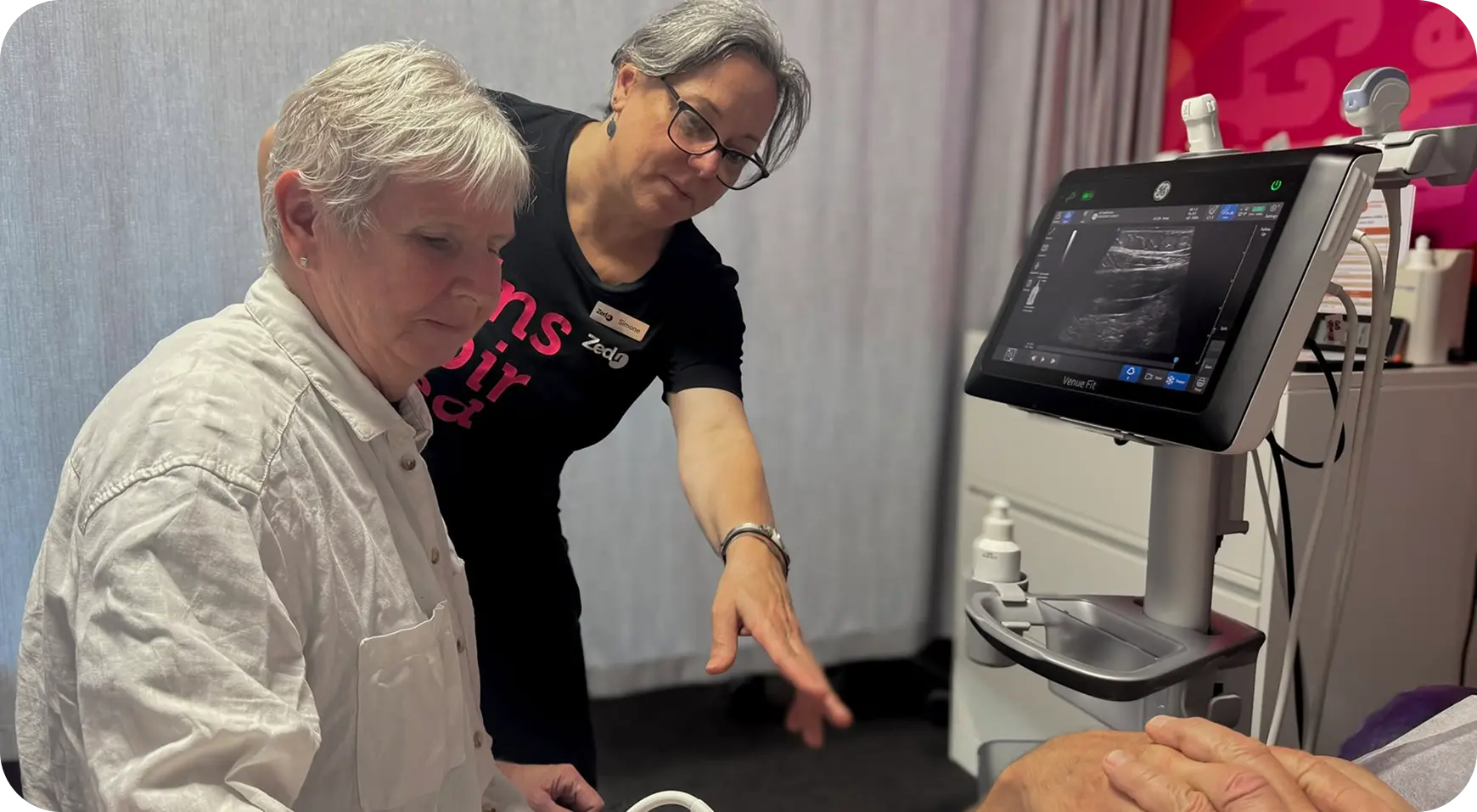
Our coaching completely removes the pressure of the clinic by using a revolutionary hack: you will practice and hone your technical skills on consenting human subjects. Because the physics of ultrasound, fluid dynamics, and tissue characteristics are identical, learning to dial in a perfect image doesn’t require an animal. Humans can hold their breath, change positions on command, and give you the uninterrupted time you need to master “knobology.”
That said, we know there’s nothing quite like the real thing—so if you would like to bring your own dog along, we are more than happy to practice on them in a relaxed, controlled environment. Alternatively, we can fast-track your foundational skills at our training headquarters first, and then come directly to your clinic to work side-by-side with you through your actual furry patient list in real time.
What Do You Get Out Of The Training?
You will focus entirely on developing your 3D spatial perception, learning how to manipulate the probe to slice through a three-dimensional organ and translate it into a crisp, diagnostic 2D image. We bridge the anatomical gap by training your eye to recognize the universal tissue patterns—such as the distinct texture of liver parenchyma or the signature shadow of a gallstone—so that when you transition back to your four-legged patients, your muscle memory and machine mastery are already second nature.
By the end of this program, you won’t just know how to turn the machine on; you will control it with absolute authority. You can expect to walk back into your clinic with the 3D spatial awareness to rapidly locate tricky structures, the technical knack to eliminate artifacts, and the rock-solid confidence to scan efficiently without a ticking clock stressing you out. By transforming your ultrasound from an intimidating piece of hardware into your most trusted diagnostic tool, you will stop referring away revenue, elevate your standard of patient care, and finally get the massive return on investment your training deserved.
We kick things off the right way—with good coffee and a high-yield briefing to get everyone on the same page. We’ll break down ultrasound terminology through the lens of “action and consequence,” showing you exactly how a physical movement of the probe or a tweak of a dial changes the image on the screen.
This setup also opens up a rare opportunity for cross-discipline collaboration: our coaches are dedicated sonographers who have spent years studying nothing but ultrasound, meaning you get to pick the brains of specialists who live and breathe image optimization every single day. This is your chance to ask all those burning questions about why things look the way they do, demystifying the physics so it actually makes sense.
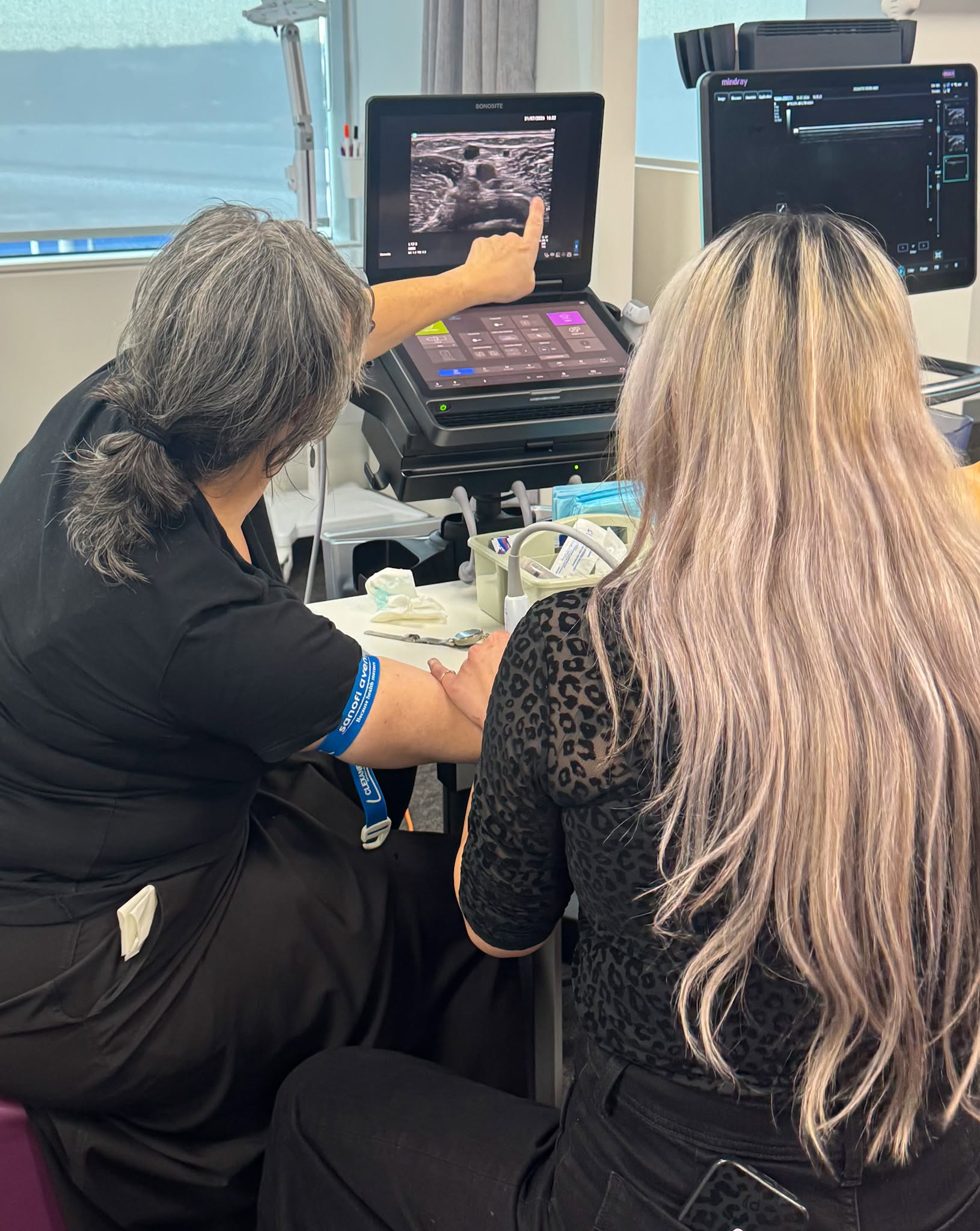
From there, we’ll dive hands-on into “knobology,” mastering the buttons until adjusting depth, gain, and focus becomes pure muscle memory. You’ll leave the guesswork behind and start operating your machine like a seasoned pro before we even look at a patient.
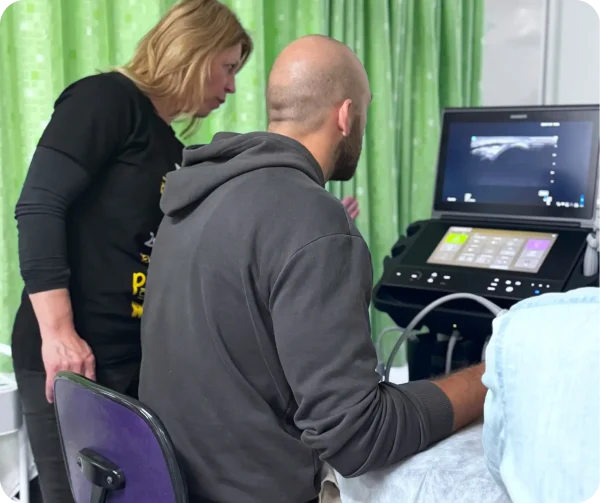
Once you’re comfortable with the controls, we bring in our two-legged models for the core scanning practice. Because humans can consent and tell us when they’ve had enough, the clinical pressure cooker is completely removed. You get the luxury of time to truly focus on how to perform a meticulous, structured evaluation of the organs without a clock ticking or a patient wriggling. We will have multiple human models available so you can practice on different body types and habitus.
If you happen to have a relaxed, cooperative four-legged friend of your own, you are more than welcome to bring them along to give it a go! Finally, to ensure you get maximum value from the day, we’ll carve out dedicated time to review real images from your clinic. Bring your trickiest files, and we will troubleshoot them together, giving you constructive feedback and actionable tips to take straight back to work.
This hands-on scanning practice is the missing link that finally unlocks the value of your previous coursework. Traditional CPD courses are fantastic for teaching you what pathology looks like, but they often lack the time to teach you how to physically find it under pressure. By stripping away the clinical chaos, our program gives you the uninterrupted time to convert that textbook theory into muscle memory. You will bridge the gap between abstract knowledge and physical execution, turning “I know what free fluid looks like in a book” into “I know exactly how to manipulate my probe to find it.”
When you return to clinical practice, this translates directly to faster, more confident diagnoses. Instead of hesitating or guessing at the controls while an owner gets stressed, your hands will automatically adjust the machine to get the crispest image possible. You will move through your scans with a structured, systematic approach, meaning you will spot abnormalities sooner, significantly reduce your scan times, and provide immediate, accurate answers to anxious pet owners right there in the consult room. This means you keep lucrative imaging and diagnostic skills in-house rather than referring that revenue out to external providers – finally stopping that fancy machine from becoming an expensive, dust-gathering paperweight in the corner of your clinic.
Choose Your Package
Select the coaching package that aligns with your current clinical goals and complete your purchase securely online. During checkout, we’ll ask you a few quick questions about:
- Your specific ultrasound learning goals and college requirements.
- Your current roster availability over the coming months.
- Any dietary requirements (so we can fuel your brain with a delicious, premium lunch on the day).
Goal Matching & Date Selection
Once your purchase is complete, our clinical coordination team will reach out to you to kickstart the scheduling process.
During registration, we will ask you to nominate your preferred dates so we can do our absolute best to match your availability with our tutors.
Together, we will establish realistic, measurable goals for your training and lock in a firm date on the calendar.
Formal Written Confirmation
Once your date and educator are locked in, we will send you a formal written confirmation with all your scheduling details, travel information, and preparation materials.
- Note: Once this written confirmation is issued, our standard terms and conditions apply.
Attend Your Training Day
Arrive at our purpose-built scanning facility for an amazing, high-yield day of deliberate and purposeful practice.
With 100% of your educator’s undivided attention and a diverse pool of live human models, you will troubleshoot your weaknesses, build deep muscle memory, and fast-track your skills.
Receive Your CDP Documentation
Following your session, you will be issued a formal Certificate of Attendance detailing your practical hours.
This documentation is ready to be uploaded directly to your college portfolio (ACEM, CICM, RACGP, etc.) to claim your professional development and CPD hours.
Yes, absolutely. We can accommodate two participants upon request. There is a small surcharge applied to the second person to ensure everyone is fully catered for with a premium lunch and that all individual documentation and CPD paperwork are correctly processed.
Before booking a shared session, there are a few important learning dynamics to consider:
- Reduced Hand-On Time: Sharing a probe means your individual scanning time will be halved. However, as we see in our group courses, this isn’t necessarily a disadvantage. Stepping back gives your brain vital breathing room to observe, process technique, and reflect on the educator’s feedback while your colleague scans.
- Pacing & Variety: Because we need to ensure both participants get equal access to the views, the overall number of different patient models or distinct scan types we can progress through on the day will naturally reduce to accommodate the extra person.
If you and a colleague have closely aligned learning goals and enjoy a collaborative, “watch-and-learn” environment, a shared session can be a highly rewarding way to train. Contact our team to adjust your package for a two-person booking.
Our primary goal is to cover the practical scanning skills required to confidently answer 2 to 3 distinct clinical questions (for example: identifying an Abdominal Aortic Aneurysm, checking for a pneumothorax, or detecting a pleural effusion). However, the exact pace depends entirely on your current scanning experience and what you hope to achieve. Many attendees are highly ambitious about what can be mastered in a single day, but true skill acquisition takes time. Educational research indicates that mastering a completely new skill typically requires around 20 hours of focused, deliberate practice to reach functional competence. In medical literature specifically, it generally takes performing 40 to 50 supervised scans to reach a safe, baseline level of clinical competence in any single application. At Zedu, we don’t believe in rushing through a checklist just to tick boxes. We work directly with you to design a realistic program that genuinely achieves your long-term learning goals. By taking into account your past training, your current frequency of clinical practice, and your individual learning curve on the day, our expert educators ensure that when you walk out our doors, you will be safe, precise, and effective out there in the clinical world.
Our standard scanning practice sessions are conducted at our dedicated . Training at our facility offers a distinct advantage: this is where we maintain an established, reliable network of live human models. Because we know their unique anatomy, we can specifically coordinate the right models to replicate the precise scanning challenges and acoustic windows you need to practice.
Yes, we can bring our training to your clinical environment upon request. In-house sessions are incredibly valuable for learning the specific nuances and settings of your own ultrasound machines, navigating the logistical layout of your department, and troubleshooting workplace ergonomic issues. If you request an on-site session, please note the following:
Yes, absolutely! We highly encourage practicing on the equipment you use every day. Before packing it up, please check in with our team first. Our Bundoora facility is fully equipped with a wide range of leading ultrasound systems, and we may already have your exact make and model available on-site for your day of training. If we don’t have your specific machine in our fleet, and your workplace device is portable, you are more than welcome to bring it along. Training on your own machine is a fantastic way to master its specific buttonology, optimize your image presets, and build direct familiarity with the exact interface you rely on during a busy clinical shift.
We always do our absolute best to match our training equipment to the exact make and model you currently use in your clinical practice.
Our Bundoora facility boasts an extensive fleet of leading point-of-care ultrasound machines. While we accommodate specific system requests whenever possible, we cannot 100% guarantee the availability of a precise model due to rotating maintenance schedules and concurrent training sessions.
If your exact machine isn’t available on the day, our educators will set you up on a system with a highly similar interface and software architecture. Rest assured, the core principles of knobology, probe manipulation, and image optimization translate across all major platforms, and we will ensure you gain skills that directly apply to the equipment waiting for you back at work.
Absolutely. We maintain strong relationships with many of the leading handheld ultrasound providers, allowing us to seamlessly bundle your practical training with the acquisition of a premium handheld device. This approach allows you to integrate your hardware and training into a single, comprehensive educational package—giving you the freedom to practice your scanning and utilize your learning materials wherever and whenever you choose.
Because everyone’s clinical goals, hardware preferences, and professional development structures differ, the best next step is to get in touch. Let us know what you are looking to achieve, and we can tailor a bundle that aligns perfectly with your specific training objectives.
Your coach is hand-picked based entirely on your unique learning objectives, your clinical specialty, and your college requirements.
We match you with the absolute best educator for the job from our elite faculty pool. Depending on your goals and current scheduling availability, your coach will be either a highly experienced (an expert in pure technical scanning, probe manipulation, and artifact troubleshooting) or a seasoned (an expert in the clinical integration and bedside interpretation of POCUS).
Regardless of who is leading your session, every single one of our educators is a master of their craft with years of dedicated clinical and teaching experience. They understand the exact high-pressure environment you work in and are trained to fast-track your hand-eye coordination safely and efficiently.
Yes, absolutely—this is one of the primary reasons clinicians choose Zedu. However, the specific paperwork process depends on your training pathway:
Most supervisors are more than happy to support this—after all, it has been over a decade since Zedu became the very first provider in Australia to establish dedicated coaching sessions for this exact purpose. We know the paperwork inside out and will ensure you leave with the documentation you need to progress.
Here is a refined version for your FAQ page that clearly manages expectations regarding formative vs. summative assessments, protecting your compliance while remaining highly supportive of their goals.
Whether we can complete your final assessment sign-off depends entirely on the strict regulations set by your specific training college. Here is how we handle assessments during your coaching session:
If you have an upcoming assessment, we highly recommend bringing your college’s specific assessment rubrics and paperwork with you on the day. We will dedicate the time to troubleshoot your sequence, eliminate any technical blind spots, and ensure you return to your department with the elite skills required to ace your final evaluation.
Let’s be completely real: true clinical competence in ultrasound takes time, dedication, and exposure to a vast array of diverse patients. It is a highly user-dependent, difficult skill to master. Our live human models come in all shapes, sizes, and age groups—and while some have manageable, stable pathologies, they are typically well. We cannot replicate, nor do we want to, a patient who is actively crashing in a trauma bay. True competence means being able to confidently apply your scanning skills to , under any level of pressure.
What our 1-on-1 coaching sessions provide is the uninterrupted, high-repetition environment required to build deep muscle memory, scanning speed, and procedural fluency. You get to practice a systematic framework for troubleshooting tricky habitus and difficult acoustic windows on stable models, ensuring that your technique is rock-solid and ready to transfer seamlessly to a critically ill patient. Beyond the probe time, your session allows you to log valuable hours, skyrocket your diagnostic confidence, and get personalized mentorship. If you’ve recently had a particularly difficult case at work, you can run it past our educators for tips and tricks on how to handle it next time. You can even bring in clinical images you’ve previously performed for expert feedback on exactly where and how to improve.
Typically, no. They are designed to serve two very different stages of your learning journey.
A group course is an excellent, highly economical way to absorb the foundations when an ultrasound application is completely new to you. Introducing a brand-new topic requires a unique educational approach, utilizing a combination of lecture-style teaching strategies, image interpretation, and introductory scanning to lay down the basic groundwork.
Our 1-on-1 scanning practice days, on the other hand, are set up quite differently. They are high-yield, high-repetition practical sessions designed around a rapid succession of live patient models, focusing entirely on refining, troubleshooting, and consolidating skills you have already been introduced to.
If we don’t currently have a group course on the calendar that meets your specific scheduling or clinical needs, we can absolutely tailor a dedicated day of private tuition for you. This allows us to blend foundational theory with 1-on-1 practical scanning built entirely around your timeline.
To bill Medicare for standalone, non-referred ultrasound imaging studies, attending a practice session alone is not enough. You must successfully complete a formal accreditation process, hold a recognized credential (such as a DDU), and ensure the ultrasound machine you are using is registered with a Location Specific Provider Number (LSPN).
If your goal is to set up a private or clinic-based billing workflow, we can certainly point you in the direction of consultants who specialize in navigating the complex Medicare and LSPN registration process. It is important to differentiate between formal diagnostic imaging billing and Point-of-Care Ultrasound (POCUS). For the vast majority of emergency physicians and acute care clinicians, ultrasound is used as an immediate bedside diagnostic tool to guide clinical decision-making. In these settings, the ultrasound scan is not billed as a standalone radiology item; instead, it is legally and clinically integrated into your overall emergency attendance or consultation item numbers.
Our scanning practice sessions are designed to give you the clinical precision and documentation standards required to safely defend those bedside decisions, regardless of how your department structures its billing.
Absolutely. In fact, career progression and transitioning into new clinical specialties are among the most common reasons qualified sonographers invest in our 1-on-1 coaching.
Whether you are trying to break out of a general scanning pool and transition into a high-demand specialty (like MSK, advanced vascular, or third-trimester obstetrics), or you are returning to the workforce after a hiatus, a standard group course rarely gives you the specific, high-repetition scan time you need to feel job-ready.
Our targeted 1-on-1 sessions are the perfect vehicle for career transitions because we can:
We will work with you before the session to analyze the job requirements of the role you want, ensuring your day of coaching is strategically designed to help you land the position.
Learn in comfort and convenience!
Your Ultrasound Guided Regional Anaesthesia Course takes place at our Melbourne Training Headquarters – Australia’s home of ultrasound training: Level 4, Unit 37 / 240 Plenty Road, Bundoora, Melbourne VIC 3083
Easy to Get Here:
- From the Airport: Just 20 minutes from Melbourne International Airport—perfect for interstate and overseas participants.
- Parking: Free and convenient in the Coles carpark directly opposite the building.
- Public Transport: Quick access via Tram 86 or buses that stop right at the door.
Nearby Comforts:
- Accommodation: Quest Hotel Bundoora is only 300 meters away.
- Shopping & Dining: UniHill DFO and nearby Uni Hill shops, including Coles, are close by for coffee, meals, or essentials.
Our venue combines professional, fully equipped learning spaces with all the convenience you need, so you can focus entirely on developing your ultrasound skills – and enjoy a smooth, stress-free course experience.
Chat to one of our team for expert advice or to organise a a specialised training course for yourself or your team.
Zedu is centrally located in Bundoora. Easily accessed from the central city and Melbourne airport (Tullamarine).

Zedu HQ - Suite 37 / Level 4
240 Plenty Road
Bundoora, Victoria 3083


Send Us A Message
Lorem ipsum dolor sit amet, consectetur adipiscing elit, sed do eiusmod tempor incididunt ut labore et dolore magna aliqua.